In the intricate tapestry of self-expression, tattoos often serve as vivid, permanent markers of personal identity. However, for some, the indelible nature of these body modifications can lead to a profound sense of regret. This is the story of individuals who, after years of living with their ink, decide to embark on the challenging journey of tattoo removal—a path that is as complex as the reasons behind their initial decision to get tattooed.
Zach Gilyard, an art director based in Brooklyn, never imagined he would join the ranks of the tattooed. His father and older siblings were heavily inked, but Gilyard, like his mother, thought tattoos were simply not for him. Yet, on a whim in 2006, he got his first tattoo—a winged foot on his ankle, symbolizing running. He kept it hidden from his family, not because he feared their disapproval, but because it felt like a rebellious act. "It was not very me," Gilyard recalled in a phone call. "I kind of liked that it was a bit of a thrill for me, because it was a time where I couldn't control the situation. I was doing something permanent."
Over the next twelve years, Gilyard accumulated several tattoos, each one a testament to a moment in time. However, his enthusiasm waned when he began a bold black-ink traditional patchwork sleeve on his left arm, starting with a panther head on his shoulder. Unlike his previous tattoos, this one left him feeling unsettled. "I always had a bit of buyer's remorse every time I got one. It would last a week or two, and then I'd be happy that I did it," he said. But this time, the feeling didn't subside. "I had it for maybe a month, and I freaked out about it—it sent me into a whole panic. I couldn't explain why. I just didn't want it, so I told myself in that moment that I was going to get rid of it."
Gilyard is not alone in his tattoo regrets. According to a 2023 Pew Research study surveying nearly 8,500 people in the US, as well as a smaller, separate study conducted in Turkey the previous year, roughly a quarter of people regret at least one of their tattoos. The reasons for regret vary widely, from personal growth and changing aesthetics to cultural or familial pressures. For Gilyard, the decision to remove his tattoos was driven by a desire to reclaim his skin and align his body with his evolving sense of self.
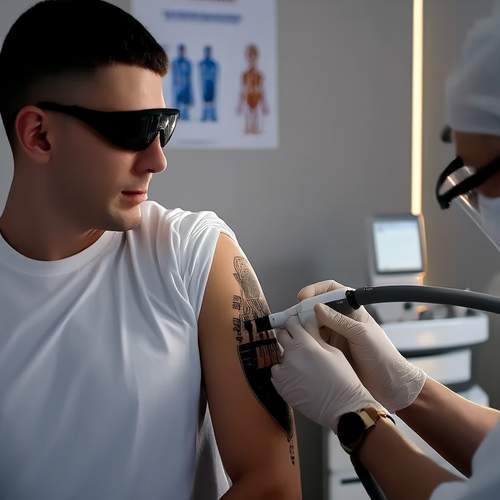
Tattoo removal has come a long way in recent years, thanks to advancements in laser technology. However, it remains a lengthy and costly process. Gilyard's journey has taken more than half a decade and several thousand dollars. His stubborn, highly saturated panther head has been reduced to a ghostly impression against the freckles on his skin, while other, smaller designs are barely noticeable. "Results do vary, person to person, tattoo to tattoo," said laser technician and tattoo artist Tim Goergen, who has been treating Gilyard at his shop, Gotham Tattoo Removal, in Brooklyn.
Tattoo ink sits in the dermis layer of the skin, the second layer, permanently because ink molecules are "too big for the body to break down," Goergen explained. Laser machines release fast pulses of energy that heat and break the ink down into tinier particles, triggering an immune response that processes them through the lymphatic system. However, the process is not without risks. A recent study in Sweden has linked tattoos—and their removal—with an increased risk for lymphoma, though its authors noted that more research is needed.
The ease of tattoo removal depends on various factors, including the age of the tattoo, the type of ink used, the design's complexity, and the individual's blood flow. Tattoos that are easier to remove are usually older, made of black ink, have finer lines, and sit closer to the heart. Goergen charges between $100 and $450 for an individual session, while Removery, a national chain, cites a range of $100-615 on its website. Predicting the number of sessions required for desired results is challenging, as "everybody's different," Goergen noted.
Sasha Goldbas-Nazarian, a resident of Los Angeles, decided to start laser treatments when she met her now-husband, who shares her Jewish faith but comes from a more conservative, Iranian family. Tattoos have long been considered forbidden or taboo within Judaism, due to interpretations of the Torah and associations with the Holocaust, though contemporary attitudes have somewhat shifted. "When we first met, he didn't believe that I was Jewish because I had tattoos," Goldbas-Nazarian recalled with a laugh. "He was like, 'I've never really met any Jews that have tattoos.'" He eventually offered to pay to remove her most visible tattoos, which she described as "younger decisions" made during high school and college.
Goldbas-Nazarian accepted, partly because her tattoos were faded and blurred, often inviting questions, and partly because covering them with makeup for formal events had become a hassle. However, she didn't anticipate how long the process would take—or that it would be much more painful than getting tattooed in the first place. "Even though (the sessions are) fast, it's still really painful. And you can smell your skin burning a little bit, which grossed me out," she recalled. She has gone for treatments on and off for years but had to pause for an extended period while pregnant and as a new mom. She has no desire to rush back, either. "Honestly, even though I still have a lot of sessions to do, I've been putting it off just because of how painful it is," she said.
Cosmetic tattoos, which enhance facial features and offer a "semi-permanent" alternative to daily makeup, have gained popularity in recent years. However, they come with their own set of challenges. Z, who lives in the UK and prefers to remain anonymous, discovered this firsthand around three years ago. Her tattoos were tiny, resembling freckles across her forehead, nose, and cheeks, intended to replace natural ones she'd lost due to a rare side effect from a severe illness. "Growing up, I had a face full of freckles—my nickname was actually 'Freckles,'" Z said. "Then I got quite poorly, and basically my freckles and all my moles faded away. And so when I was well again, I felt really weird about my face, because it felt so bare."
After seeing a YouTube video of cosmetic freckle tattooing, Z thought she could get her freckles back. "But it went very wrong for me," she said, explaining that the results didn't feel natural. "You could tell that they were drawn on." Unpleased with the outcome, she would cover them with makeup, but they still showed through. Cosmetic tattoo ink is meant to eventually fade, but it doesn't always. It also runs the risk of turning into other colors, such as pink or orange, over time or when treated with laser.
Z said she did her research and requested regular tattoo ink, but she does not believe her practitioner honored that request. Having more melanated skin put Z at a higher risk of hypopigmentation, a loss of skin pigment, during her tattoo removal. "There is no guarantee of perfect removal for any skin type, but it does become a little bit tougher on darker skin types," explained Jordan Butler, founder of JHB Tattoo Removal, who has been treating Z. "A lot of people that have come in and seen me in the past... have been told that they can't have (a) tattoo removal, that it's not possible. It's definitely possible in most cases."
Though better laser technology in recent years has improved results and lessened unwanted outcomes such as hypopigmentation, Butler and Goergen emphasized that the outcome depends on a technician's knowledge and care. Ink pigment colors are targeted using different wavelengths, and some (like the one that targets warmer shades) are more "aggressive" than others. "It's possible to strip natural melanin out of the skin with the red or orange or yellow (inks)," Goergen explained. That's why patch-testing is crucial, Butler said, which he did extensively with Z. Her first session was painful, but the discomfort has lessened over time. "Now it's barely anything," she commented. Her healing has been straightforward, and she feels that she is almost there. "It's so much better than what it was," she said.
Jayne Foo, a financial consultant based in Singapore, has experienced the more extreme side of recovery over the past few months as she embarked on the removal of around 70% of her tattoos, including one of her two full sleeves, a chest piece, and a large stomach piece. For her 14,600 followers on Instagram, she is documenting the entire laborious experience—open wounds, fluids, and all. Redness, soreness, and swelling are common, but blistering can also occur, which Foo experienced after both of her first two sessions. "I always knew I wanted to get tattoos, but as a young girl, I never had the money to get nice tattoos, so I just plastered anything I wanted on my body without thinking of how it would look in the future," she said. On why she's getting the tattoos removed now, she added, "I want a fresh start. I want to reclaim my skin."
Foo is not the first influencer to document tattoo removal, and some have begun partnering with clinics to promote and show results. However, videos on social media are often limited to the session itself, which can be deceptive due to "frosting," a temporary lightening effect that occurs briefly (for about 15-20 minutes) when the laser hits the ink, before returning to normal. Foo's videos show the hours and days following her treatments, during which she experienced large, intense blistering and extreme itching from the scabbing that followed. "The first time I had it done, my arm swelled up twice the size," she recalled. "I wasn't expecting that at all."
For the first few days of healing, Foo chose to remain indoors completely to minimize contact. "It's just too much of a hassle to leave the house," she said. "You have to be very mindful of your surroundings and keep yourself clean." Foo said she will continue to chronicle her treatments, as "it's important to be real about it." Accustomed to documenting many parts of her life online, including her fitness and travel, she also thought it would be "weird" to "suddenly not have tattoos" in her posts.
Conversely, Gilyard has taken a more discreet route and kept his removal process mostly private—once again, including from his parents. Though they eventually noticed his faded tattoos. "My dad finally looked at my tattoos one day and asked why they look like an old man's," Gilyard said. "My mother just asked me how much it cost and asked me how much the tattoos themselves cost, and just said it was all a waste of money," he laughed. "But I think she's happy that some are going away."
The journey of tattoo removal is a testament to the evolving nature of personal identity and the desire to reclaim one's body. For Gilyard, Goldbas-Nazarian, Z, and Foo, the process is as much about physical transformation as it is about emotional and psychological growth. As they navigate the challenges of removing their ink, they are also rewriting their stories, one laser session at a time.

By /Aug 18, 2025

By Daniel Scott/May 27, 2025

By Rebecca Stewart/May 27, 2025

By Christopher Harris/May 27, 2025

By /Aug 18, 2025

By Jessica Lee/May 27, 2025

By Amanda Phillips/May 27, 2025

By Noah Bell/May 27, 2025

By /Aug 18, 2025

By /Aug 18, 2025

By /Aug 18, 2025
By Megan Clark/May 27, 2025

By Sophia Lewis/May 27, 2025

By /Aug 18, 2025

By /Aug 18, 2025

By David Anderson/May 27, 2025

By /Aug 18, 2025

By Joshua Howard/May 27, 2025

By /Aug 18, 2025

By /Aug 18, 2025
