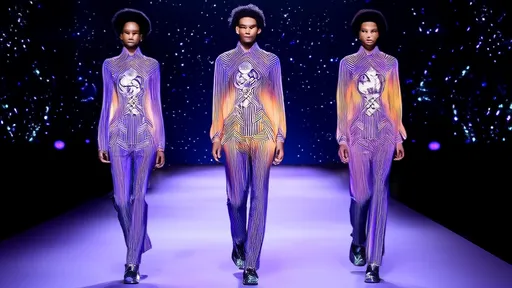
In a bold fusion of fashion and fragrance, Chanel’s research lab has unveiled a groundbreaking concept: clothing that visually responds to the wearer’s perfume. This innovative approach to "scented dressing" utilizes temperature-sensitive fabrics that shift colors and patterns when exposed to the chemical compounds of fragrances, creating a dynamic interplay between scent and style.
The project, still in its experimental phase, explores how garments can become an extension of personal fragrance. When sprayed with perfume, the specially treated fabrics react to subtle changes in skin temperature and the alcohol evaporation process, revealing hidden designs or altering hues. A spritz of Chanel No. 5 might coax forth golden floral motifs, while the citrus notes of Chance could trigger vibrant geometric patterns.
Behind this alchemical marriage of textiles and perfumery lies years of material science research. Chanel’s team developed proprietary fabric blends containing microcapsules of thermochromic dyes—substances that change color at specific temperature thresholds. These capsules rupture when activated by the warmth of perfumed skin or the cooling effect of alcohol evaporation, releasing their chromatic transformations.
The visual changes aren’t instantaneous theatrical effects but rather subtle, organic transitions that mirror perfume’s dry-down phase. Just as a fragrance evolves on skin over hours, the garments undergo gradual chromatic shifts. This creates what Chanel’s lead researcher calls "olfactory couture"—clothing that tells the story of a perfume’s development through visual language.
Practical applications remain speculative but tantalizing. Imagine a little black dress that blooms with embroidered camellias when worn with Chanel’s Gardenia fragrance, or a business suit whose pinstripes intensify with each application of Bleu de Chanel. The technology could revolutionize how we coordinate scents with outfits, moving beyond mere color coordination to true multisensory harmony.
Critics question whether this represents meaningful innovation or mere gimmickry. Yet the project undeniably pushes boundaries in both fashion and fragrance industries. It challenges designers to consider scent as a fundamental design element rather than an afterthought, while prompting perfumers to create juices specifically engineered to interact with smart textiles.
The temperature-sensitive fabrics currently respond to about a dozen Chanel fragrances, with plans to expand the olfactory palette. Each perfume triggers distinct visual responses based on its chemical composition—floral aldehydes produce different effects than woody amber notes. This creates an entirely new vocabulary for expressing fragrance families through visual media.
Technical hurdles remain before scent-reactive clothing hits boutiques. The color-changing effects currently last only through several wearings before the thermochromic dyes exhaust their reactivity. Chanel’s material scientists are working to extend this lifespan while maintaining the fabrics’ luxurious hand feel—no small feat when incorporating advanced technologies into haute couture textiles.
Beyond the laboratory, this innovation sparks philosophical questions about fashion’s ephemerality. If clothing can change its appearance based on something as transient as applied fragrance, does this represent the ultimate expression of disposable fashion? Or does it instead create garments with infinite visual possibilities—a single piece capable of telling countless olfactory-visual stories?
The project also raises intriguing possibilities for sustainability. Imagine clothing that visually signals when it needs cleaning based on odor molecules detected in the fabric, potentially reducing unnecessary washing. Alternatively, the technology could lead to garments that change appearance when exposed to environmental pollutants, serving as wearable air quality monitors.
Chanel plans to debut the first prototypes at an upcoming fragrance exhibition, where visitors can witness the color transformations in real time. While commercial availability remains years away, the very existence of this research demonstrates how traditional fashion houses are embracing radical innovation at the intersection of technology and tradition.
This isn’t the first time Chanel has experimented with responsive textiles—the house previously developed fabrics that change with sunlight exposure—but it marks their most ambitious attempt to bridge the gap between olfactory and visual aesthetics. The project represents a natural progression for a brand built on both iconic fragrances and revolutionary fashion.
As wearable technology continues evolving beyond fitness trackers and smartwatches, Chanel’s vision points toward a future where clothing serves as a canvas for personal expression across multiple sensory dimensions. The garments we wear may soon communicate not just our style preferences through cut and color, but our scent identity through dynamic visual transformations.
The fashion industry watches closely as this technology develops. Should Chanel succeed in creating durable, commercially viable scent-reactive apparel, it could spark a revolution in how designers approach both fragrance launches and clothing collections. We may be witnessing the birth of an entirely new category at the intersection of perfumery and fashion—one where what you wear and how you smell become inextricably linked through the magic of material science.

By /Aug 18, 2025
By Daniel Scott/May 27, 2025
By Rebecca Stewart/May 27, 2025
By Christopher Harris/May 27, 2025
By /Aug 18, 2025
By Jessica Lee/May 27, 2025
By Amanda Phillips/May 27, 2025

By Noah Bell/May 27, 2025

By /Aug 18, 2025
By /Aug 18, 2025
By /Aug 18, 2025

By Megan Clark/May 27, 2025

By Sophia Lewis/May 27, 2025

By /Aug 18, 2025
By /Aug 18, 2025
By David Anderson/May 27, 2025

By /Aug 18, 2025
By Joshua Howard/May 27, 2025

By /Aug 18, 2025

By /Aug 18, 2025
